Schwerkraftmaschine Drum Smasher Explained
- 31.01.2017
- Michael Krusch
- Story
- Schwerkraftmaschine
Part 8 of our review of the different compression modes in the Schwerkraftmaschine
Sometimes it just has to be.
You just let it all hang out.
Turn up all the knobs to the max.
Screw good manners.
Press all the buttons at once.
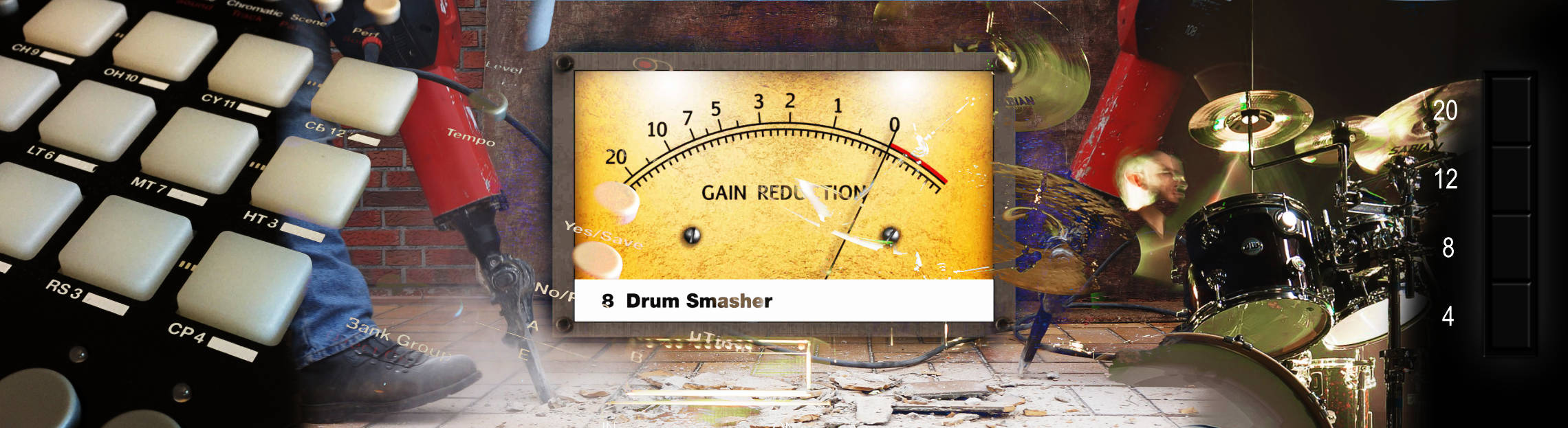
That's what Drum Smasher is for.
It compresses with everything it's got.
And in the process gives the drum overheads the right definition and punch.
If you turn the attack and release dials all the way to the left, it immediately clamps down on the signal. If you turn the knobs up a bit, then more transients begin to come through, providing more punch.
The attack and release also have program-dependent behaviors. In other words, they react less to short impulses than to longer ones, letting the transients shine through a bit more.
Full throttle, but not out of control.
If the effect gets too aggressive, the mix knob can get it back under control.
What "Program-Dependent" Means Here
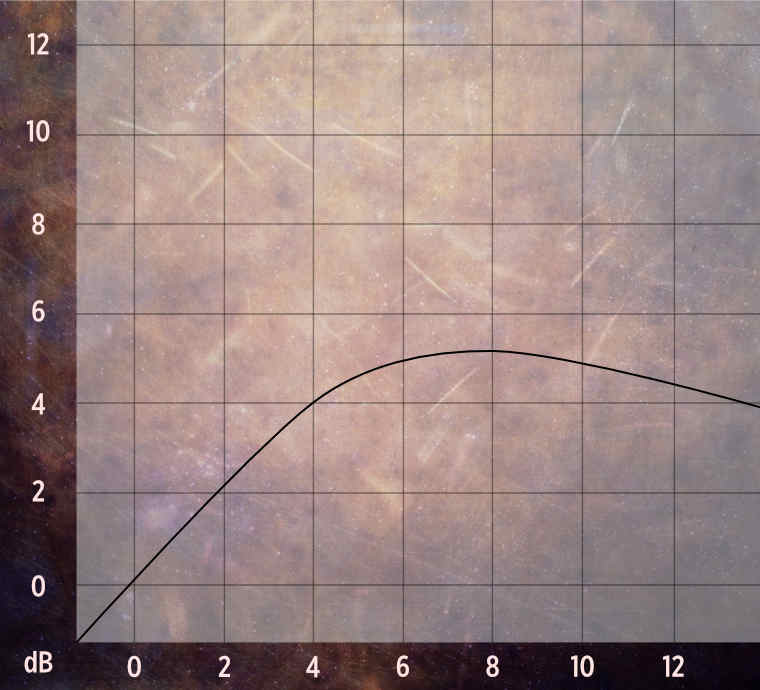
With a classic compressor you set attack and release, and the compressor sticks to them – whether a short snare hit or a long crash decay comes along. The Drum Smasher looks at the signal: it reacts less to a short impulse and more to a longer event. The hit comes through, the decay gets denser – that's what gives overheads definition and punch. The curve on the right shows how seriously the mode takes its name: from about 8 dB above the threshold, the output level actually drops again – louder in means quieter out. All of this is possible because the Schwerkraftmaschine generates its control signal digitally in the side chain – the control behavior is freely programmable there.
How to Use the Drum Smasher
Its natural home is overheads and the drum bus, ideally in parallel: knobs to the left, then bring up the mix knob until the punch is there but the transients of the dry track still lead. Turning attack and release up brings more of the hit into the compressed signal – the character stays strong but opens up. Because the mode grabs so hard, the side-chain filter matters: use the low-cut to keep the kick from driving the compression, and the tilt EQ to decide whether cymbals or shells push the compressor. And whatever the force, what remains is the Schwerkraftmaschine's tube and transformer sound – three transformers and four triodes per channel – giving even heavily squashed drums roundness and presence.
The Video: Drum Smasher in Action
Interested in testing the Schwerkraftmaschine for 14 days in your studio?
Simply register here
The Series: All 11 Compression Modes of the Schwerkraftmaschine
Part 1: Multi-Band Complex · Part 2: Diode Pressor · Part 3: Breakthrough · Part 4: Stereo Transformer (MS Processing) · Part 5: Schwerkraftmaschine vs. Vari Tube Compressor · Part 6: Vocal Leveler · Part 7: Optical Compressor · Part 8: Drum Smasher · Part 9: Classical VariMu · Part 10: Chart Analysis · Part 11: Deesser
Related: Schwerkraftmaschine Breakthrough Explained – the opposite approach with a 6 dB ceiling · Schwerkraftmaschine Diode Pressor Explained
