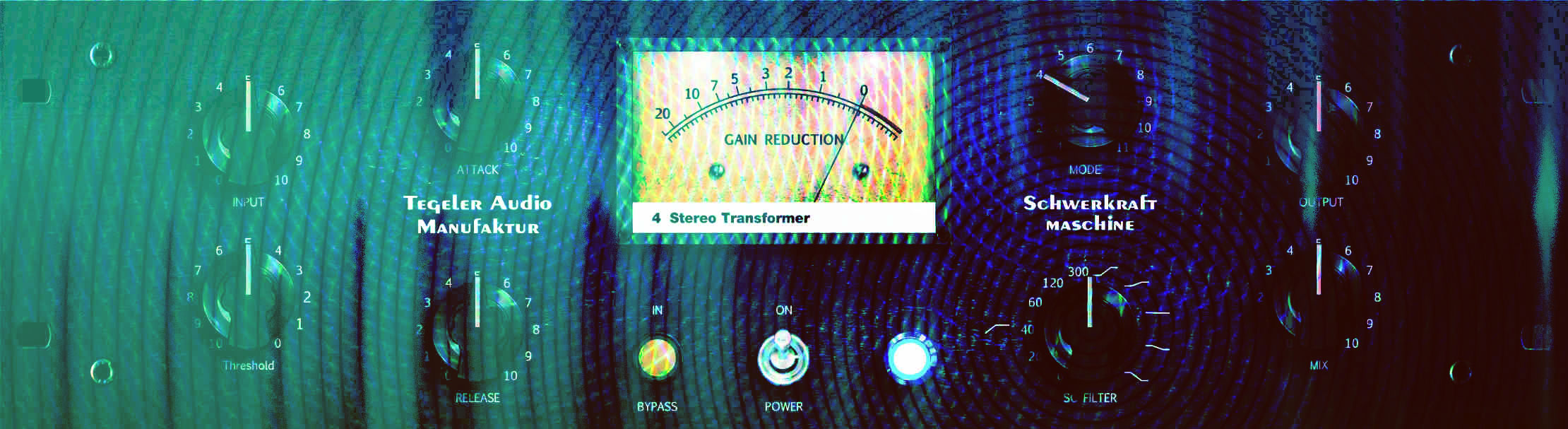
Schwerkraftmaschine Stereo Transformer Explained
- 18.01.2017
- Michael Krusch
- Story
- Schwerkraftmaschine
Part 4 of our review of the different compression modes in the Schwerkraftmaschine
What MS Processing Is – and Where It Comes From
MS processing has been a buzzword for some time now.
Separate processing of the middle and side signals is hardly new.
It was historically used to reduce the width of the base of low-frequency signals so that the needle wouldn't fly out of the groove when the song was pressed onto vinyl.
It has its origins in MS stereophony, where recording was captured via an omnidirectional microphone as the M signal, while the S signal comes from a bi-directional microphone turned toward the null position for its sound source.
Depending on how loud the two signals are parameterized in relation to one another, the technique lets the engineer choose the amount of room ambiance — even when the final result is a mono signal.
How the Schwerkraftmaschine achieves this
Naturally you can control the Schwerkraftmaschine using either our Konnektor or another MS/LR matrix in MS mode.
But you can also go without.
Stereo Transformer mode harnesses this option to react differently to the M and S signals.
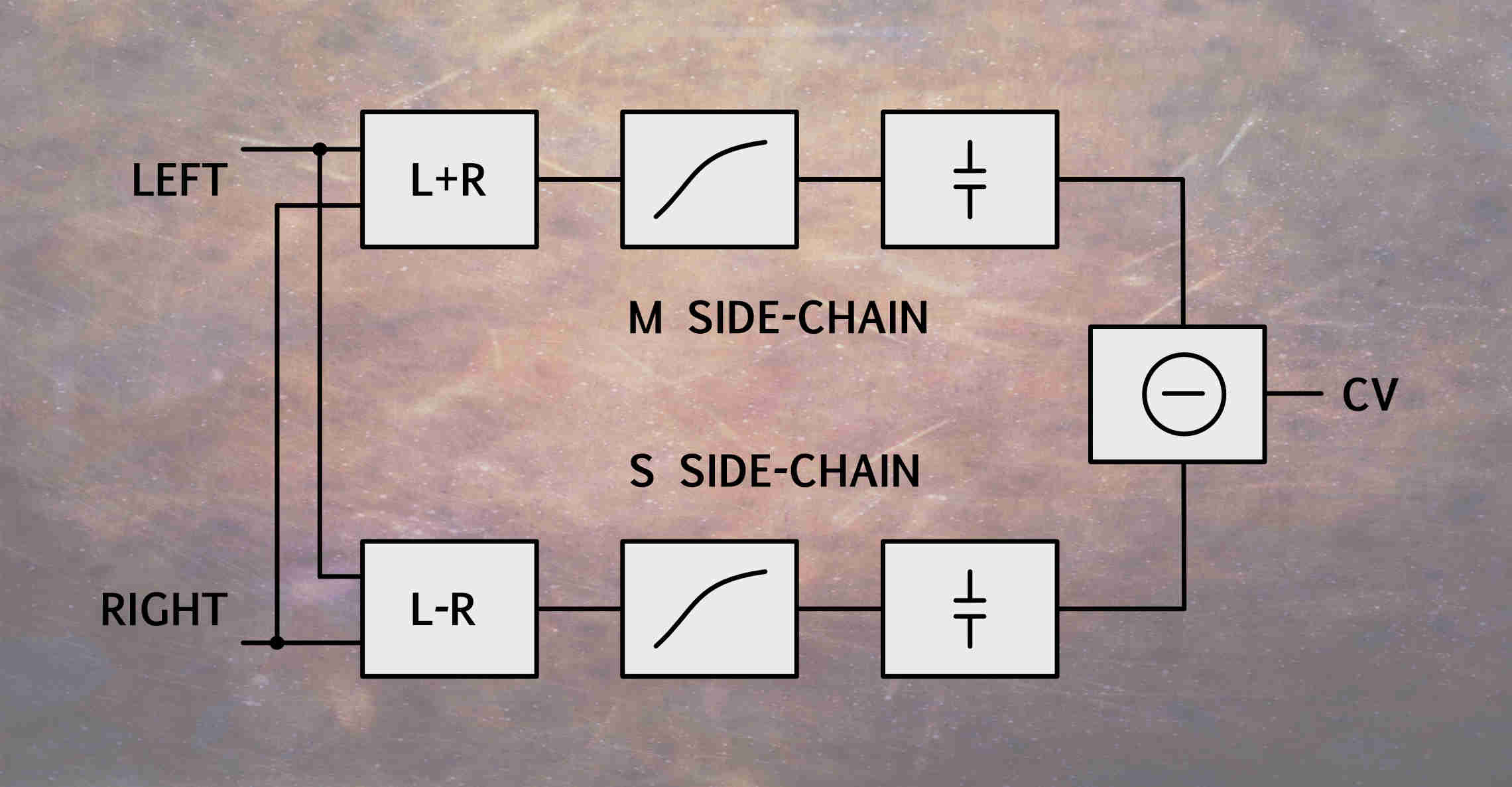
The left and right channels of the audio signal are added into the side-chain in an M signal, but are subtracted from one another in the S signal.
The two signals are then run through their own separate side chains.
At the end, the control signal from the S channel is subtracted from the control signal on the M channel.
The M channel thus provides the compression, while the S channel is used for attenuation.
One thing to keep in mind: the audio path itself stays left/right. The Schwerkraftmaschine doesn't encode the signal into M and S – it only does the math in the side chain. That's why no matrix or extra unit is needed, and the tube gain element keeps working normally on both channels. If you want true MS compression with separate processing of mid and side, combine the Schwerkraftmaschine with an LR/MS and MS/LR matrix (the Konnektor, for example) and use dual-mono mode via the plug-in. Stereo Transformer isn't meant for that setup, though – it's designed for the normal stereo signal.
How does it sound
Because a mix represents a constant sequence of diverse stereo events, this mode constantly changes the compression to reflect the placement of the signals within the stereo panorama.
A drum loop within the stereo space will be compressed differently than when run solo.
Once again, there's no substitute for trying it out on your own, as the effect on the stereo image is difficult to describe in words.
In practice: signal content in the center drives the compression, while wide stereo content pulls it back. The more width in the signal, the less the compressor squeezes. How strong the effect is depends on the material; as in all modes, the amount can be dialed in with the mix knob and the frequency focus set with the side-chain filter.
The Video: Stereo Transformer in Action
Interested in testing the Schwerkraftmaschine for 14 days in your studio?
Simply register here
The Series: All 11 Compression Modes of the Schwerkraftmaschine
Part 1: Multi-Band Complex · Part 2: Diode Pressor · Part 3: Breakthrough · Part 4: Stereo Transformer (MS Processing) · Part 5: Schwerkraftmaschine vs. Vari Tube Compressor · Part 6: Vocal Leveler · Part 7: Optical Compressor · Part 8: Drum Smasher · Part 9: Classical VariMu · Part 10: Chart Analysis · Part 11: Deesser
Related: Schwerkraftmaschine Multi-Band Complex Explained – another multi-channel side chain · Julien Doré Tour FOH: Creme, Schwerkraftmaschine
