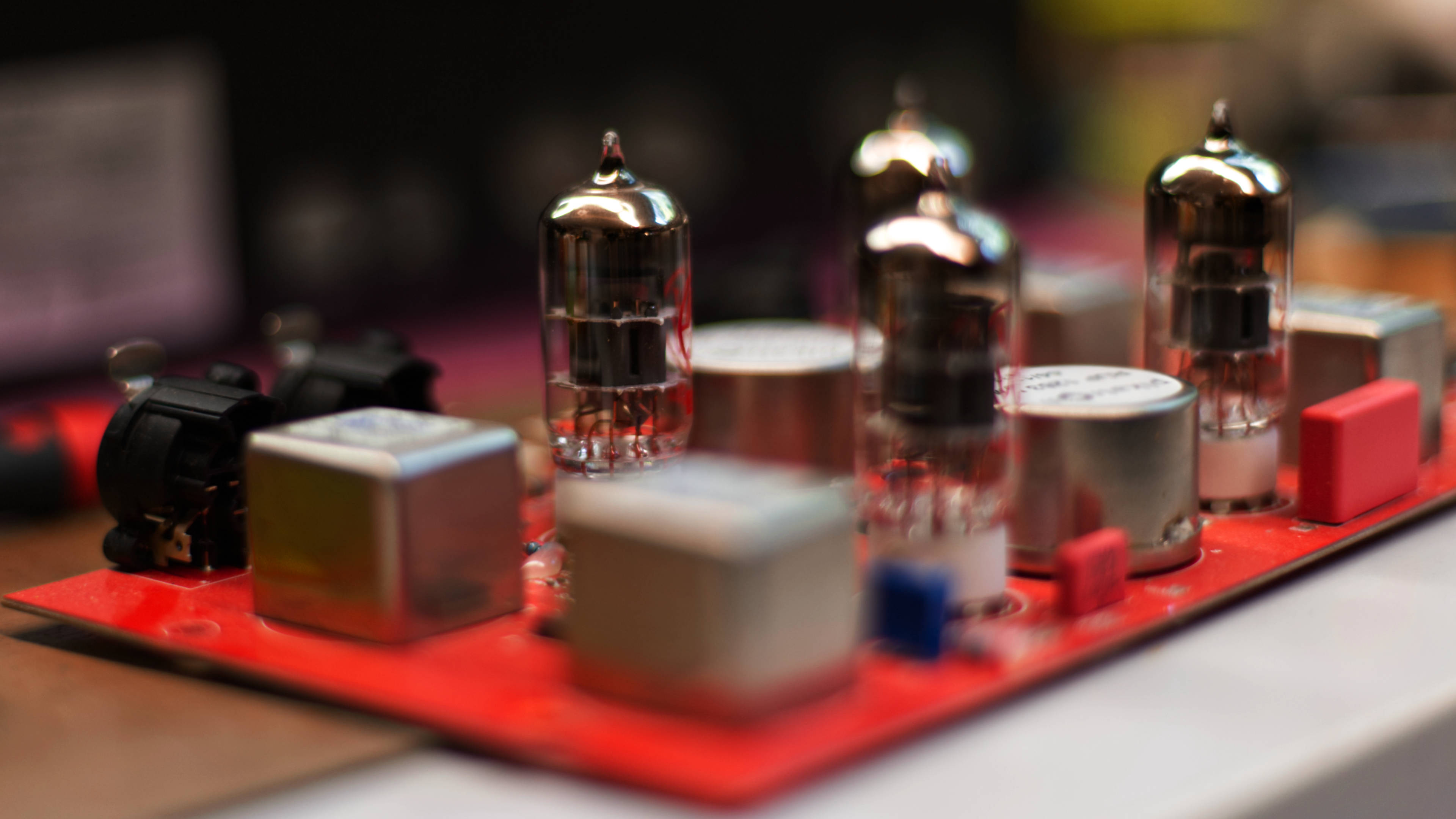
What Tubes and Transformers Do to Your Signal
- 13.09.2026
- Michael Krusch
- Story
- Basics
- VTC
- EQP-1
Everybody in audio has heard it: tubes sound warm, transformers add iron, and a tube compressor is somehow more musical than a plug-in. Ask what that actually means and you get a shrug, a forum thread, or the same three sentences about even harmonics that every plug-in manual repeats. Ask what it does to a mix on the meter and the answer is usually "you have to hear it."
We build units that have both parts in the signal path: the Vari Tube Compressor, the Schwerkraftmaschine, the Classic Equalizer EQP-1, the Vari Tube Recording Channel, the Tube Summing Mixer and the Raumzeitmaschine, one unit with a single output transformer and no tube, and one unit, the Creme, that deliberately has neither. So here is the explanation from the workshop: what a tube and a transformer are doing in a circuit in the first place, what each of them adds to the signal and why it depends on level and frequency, what the two do together, what they do not do, and where you find them in our units, including what our own measurements show.
In this article:
- Two parts, two jobs: the tube amplifies, the transformer couples
- What the tube adds: harmonics from a curved transfer characteristic
- A soft knee instead of a hard edge: why it depends on level
- What the transformer does: iron, hysteresis, and why the bass goes first
- Tube plus transformer: what reaches your ears
- What tubes and transformers do not do
- Tubes and transformers in our units: where they sit, how you hear them, how long they last
Two parts, two jobs: the tube amplifies, the transformer couples
Neither part is in the box for its sound. A vacuum tube is an amplifier. A heated cathode emits electrons, a plate collects them, and a grid in between controls how many get through. A small voltage on the grid becomes a larger voltage at the plate. That is all a tube does, and in a compressor, an equalizer or a channel strip it does it at several points: at the input, as make-up gain after a passive filter network, or as the gain element itself in a Vari-Mu compressor, where the control voltage changes how much the tube amplifies. How that last trick works is its own article, Vari-Mu Compressor Explained; this one is about what the tube does to the signal that passes through it.
A transformer is two coils of wire on a common iron core. The signal in the primary coil creates a changing magnetic field, the field induces the same signal in the secondary coil, and nothing else crosses the gap. That buys a circuit designer three things: a balanced connection at the input and output, isolation from ground loops and hum, and a way to match impedances and voltage levels between stages. Jörg Hoffmann described the path through the Vari Tube Compressor for Amazona.de in 2023 as a signal that runs "not only through tubes, which mainly add harmonic distortion to the signal, but also through a series of transformers that convert the signal from current into a magnetic field and back into current, adding further nonlinearities" (translated; the review is summarized in Amazona.de on the VTC: Tubes for Connoisseurs).
That word, nonlinearities, is the whole story. A perfectly linear stage puts out exactly what came in, only larger or smaller. Neither a tube nor a transformer is perfectly linear, and the ways in which each one deviates are different, predictable, and audible. The rest of this article is about those deviations.
What the tube adds: harmonics from a curved transfer characteristic
Every tone you record is a fundamental plus harmonics: components at two, three, four times the fundamental frequency. The second harmonic is one octave above the note, the third is an octave plus a fifth, the fourth is two octaves. A cello and a clarinet playing the same note differ mainly in how strong each of these is. Harmonics are not distortion; they are the sound of the instrument.
A tube adds harmonics of its own because its transfer characteristic, the curve that maps input voltage to output voltage, is not a straight line. It is gently curved over its whole range, not just at the extremes. Push a pure sine wave through a curved line and the output is a slightly bent sine, and a bent sine is, mathematically, the original plus new components at multiples of its frequency. The shape of the curve decides which multiples appear. A curve that bends differently for the positive and negative half of the wave, which is what a single tube stage does, produces even harmonics, the second above all, plus a smaller share of odd ones. A curve that bends the same way in both directions produces only odd harmonics. That second case is what a push-pull stage does: two tubes handle the two halves of the wave symmetrically, and their even harmonics cancel.
This is where the popular shorthand comes from, and where it falls apart. The shorthand says tubes make even harmonics, which sound warm, and transistors or tape make odd harmonics, which sound harsh. Paul White summarized the audible side of it in Sound On Sound in 2010: "Even-order harmonic distortion tends to sound musically sympathetic, smooth, and bright in a constructive way," while odd-order distortion "tends to sound rough or harsh, gritty or edgy." That is a fair description of what strong, high-order distortion sounds like. But Hugh Robjohns, in the same magazine two months earlier, made the point that matters for a piece of studio gear: "the circuit topology is far more influential over the amount and character of distortion than the type of active device actually being used." A single-ended triode stage does produce a lot of second harmonic. A push-pull amplifier stage, run in its linear range, produces almost none. Whether a "tube" unit makes even or odd harmonics is decided by the designer, not by the glass.
Our own Vari-Mu gain stage is a push-pull stage, and it has to be: the control voltage that regulates the tubes cancels between the two halves, which is the only way to keep it out of the audio. But this is also where topology stops predicting the spectrum. A Vari-Mu compressor only works with tubes that have a nonlinear region, and it works only in that region: the control voltage moves the operating point along the curved part of the characteristic, because that is what changes the gain. The stage that regulates is, by design, a stage that runs on curvature, and a push-pull arrangement does not dictate which harmonics come out of it. Michael Krusch wrote in 2017, in Schwerkraftmaschine: Classical VariMu Explained, that the harmonics added by this symmetrical stage differ from those of a single-ended stage and produce a pleasant spectrum that gives the music more liveliness and definition. Add the other tube stages and the transformers, which, as the transformer section below shows, contribute odd harmonics of their own, and what comes out at the output is the sum. The sum is what we measured; it is in the last section.
A soft knee instead of a hard edge: why it depends on level
The second thing the curved characteristic gives you is the way the tube behaves when the signal gets big. A transistor stage with feedback is very linear until it runs out of supply voltage, and then it stops, abruptly: the top of the wave is cut off flat, and a flat-topped wave is a spray of high-order harmonics that nobody calls warm. Robjohns describes tube stages as curving "fairly smoothly into saturation," with "musically 'friendly' intermodulation products," while in solid-state circuits signal peaks beyond the linear range typically "immediately enter a very abrupt non-linear region."
The practical consequence is that a tube stage has no single point where it starts to color the signal. At low level it is close to linear and adds very little. As the level rises, the second and third harmonics rise faster than the signal itself, and the top of every peak gets pressed down a little before it is ever clipped. Michael described that progression for the input stage of the Raumzeitmaschine, which is built so that the converter behind it can never clip: drive the input with a hotter signal and "the input transformer and the tube stage will slowly compress the peaks more and more, then at some point add even more harmonics than they already do, and at some point distort in an analog way. Always staying musical. No hard converter clipping" (translated).
Three stages, then: peaks get rounded, harmonics grow, then it distorts. Which of the three you are in is set by the level, and that is why the input control on a tube unit is a color control as much as a gain control. On the Vari Tube Compressor the Color/Comp switch takes the compression out of the path entirely and leaves only the tubes and transformers working, and the input knob then decides how hard you drive them; that was the point of the switch, described in New VTC: Color/Comp Switch for Pure Tube Color. It is also why a tube unit on a full mix, run at sensible level, seems to "do almost nothing" on the meter and still changes how the mix feels: the peaks, which are the loudest and shortest events in the signal, are exactly where the curve bends most.
What the transformer does: iron, hysteresis, and why the bass goes first
A transformer's nonlinearity lives in the iron. Bill Whitlock of Jensen Transformers wrote the chapter on audio transformers in the Handbook for Sound Engineers, and his description gets it right: "Distortion in audio transformers is different in a way which makes it unusually benign. It is caused by the smooth symmetrical curvature of the magnetic transfer characteristic or B-H loop of the core material." Symmetrical curvature means, as in the tube section above, odd harmonics: Whitlock measures the products as "nearly pure third harmonic."
Two mechanisms, both in the core, both strongest at low frequencies. The first is hysteresis: the iron does not follow the magnetic field instantly and keeps a little residual magnetism when the field reverses. Whitlock: hysteresis "causes increased harmonic distortion for low-frequency signals at relatively low signal levels." The second is saturation: at high field strength the core "essentially los[es] its ability to conduct any additional flux," and the distortion of low-frequency signals rises steadily with level "beyond a threshold." How much field the signal creates depends on voltage divided by frequency, so a 50 Hz tone works the core twenty times harder than a 1 kHz tone at the same level. The gradient Whitlock measures on a high-nickel core makes the point: the distortion roughly quarters for every doubling of frequency. Whatever a transformer does to your mix, it does it to the bass and low mids first, and to the hi-hat last.
That gives transformers a signature no other component has. Robjohns puts it as thickening "up low-level sounds more than high-level ones, while some active gain stages (particularly triode valves) tend to do the reverse," which is the hysteresis effect on the transformer side and one reason the two parts complement each other, and a slightly denser, rounder bottom end at high level, which is the approach to saturation. The core material decides how much of either you get: silicon steel cores color more, high-nickel cores stay cleaner, and both are legitimate design choices. Our own description of what the transformers do in the Vari Tube Compressor, from the article on the Color/Comp switch, is that the bass gets tidier and the top end gets rounded off.
The top end is the transformer's second job. Leakage inductance and winding capacitance form a low-pass filter at the high end, and, as Whitlock explains, that filter has two reactive elements and therefore depends on damping: under-damped, it rings on fast transients; over-damped, it rolls off early. Robjohns observes the same from the listening side, "ringing on HF transients" or "slightly reduced bandwidth," depending on the design. A well-designed transformer sits between the two, with a smooth extension beyond the audio band and a transient response that softens the very edge of a hi-hat without blurring it. A specification like 20 Hz to 40 kHz on a transformer-coupled unit tells you the designer took that seriously.
If this sounds like what tape does, it is a cousin, not a twin. Tape saturates the high frequencies first, a transformer the lows first, which is why "tape saturation without tape" is a different topic; we wrote about it in Magnetismus 2: Tape Saturation Without Tape?.
Tube plus transformer: what reaches your ears
In the Vari Tube Compressor the signal passes through three transformers and four triodes per channel before it leaves the box. None of these stages, on its own, does anything dramatic. Each one adds a fraction of a percent of harmonics at working level, each one rounds the peaks slightly, each transformer works the bass a little. In series, the fractions add up to something you can measure and hear.
Three things happen when the stages combine. The first is a harmonic spectrum that is neither the pure second of a single triode nor the pure third of a transformer, but a blend that is fixed by the design and shifts with level. The second is intermodulation: a nonlinear stage does not only create harmonics of single tones, it creates sum and difference tones between every pair of tones in the signal. In a hard-clipping stage those products are the reason distorted mixes sound congested. In a gently curved stage they are low in level and, for tones that are harmonically related to begin with, mostly land on musically related frequencies, which is what Robjohns means by "friendly." The third is the rounding of transients, and Robjohns holds that frequency response alone is not enough to explain the impression of warmth; what analog stages do to transients is, in his words, "far more important."
That last point explains something that confuses people about tube compressors. The color happens before the compression and independently of it. In the VTC the tubes and transformers shape the signal on its way through the box whether or not the gain reduction meter moves; the Vari-Mu regulation is a separate function that works on top of that. In the Classic Equalizer EQP-1 the same is true with the EQ set flat: the passive filter network does nothing, the tube make-up stage and the transformers still do their job, which is why the unit changes a mix as soon as it is in the path. "Glue" is a word people use for compressors, but a good part of what they are hearing is the path, not the regulation.
What tubes and transformers do not do
They do not make anything automatically warm. The classic tube microphones of the 1950s were designed to be as linear as their designers could manage, and according to Paul White, modern recreations "that deliberately add more tube distortion than the bare minimum generally sound less musical than correctly designed tube mics." A tube unit that adds a fraction of a percent of second harmonic at working level is doing what those classics did: distorting as little as the circuit allows. A unit that adds ten percent is an effect, and there is nothing wrong with an effect, as long as nobody calls it transparency.
More tubes is not more sound. A tube count on a spec sheet says nothing about the topology or the operating point. Two triodes in a symmetrical amplifier stage can add less even-order harmonic than one triode single-ended, and a Vari-Mu stage runs its tubes in the nonlinear region on purpose.
Even versus odd is a rule of thumb, not physics. Both kinds appear in almost every real unit, the proportions shift with level, and low-order harmonics of either kind at low level are heard as density and presence rather than as "distortion." What sounds harsh is high-order content, roughly from the seventh harmonic upward, and that comes from hard clipping, regardless of the device that clips.
Swapping tubes is not an upgrade. In a Vari-Mu compressor the two tube systems of the gain stage have to have matching characteristics or the control voltage leaks into the audio; Michael wrote in 2017 that trying those great NOS tubes from eBay usually ends in disaster in a Vari-Mu compressor, and that nothing works without selected tubes and a fresh calibration (translated). The tubes in a unit like this are a calibrated part of the circuit, not a flavor cartridge.
Plug-ins are not nothing. A static harmonic spectrum, second harmonic at minus fifty decibels, third at minus sixty-five, is easy to model, and good saturation plug-ins do. What is hard to model is the way three transformers and four tubes in series shift that spectrum with level and frequency, every millisecond, on a signal with a thousand components. Pontus Hagberg rebuilt a hardware mix entirely in the box for Sound On Sound in 2024 and got there with level matching and oversampling; we quoted that in Analog Mastering Chain: What Goes Where and Why and we stand by quoting it. Whether the difference matters to you is a listening test at matched level, not an argument.
And it is taste. Hans Jürg Baum, writing about tube sound in 2000, put it this way: "with sound, it is like fashion" (translated), and he was right. Some records want the path as clean as possible. Ours are built for the ones that do not.
Tubes and transformers in our units: where they sit, how you hear them, how long they last
Where they sit. The Vari Tube Compressor runs each channel through three transformers and four triodes in Class A, with the Vari-Mu gain stage in the middle; the Color/Comp switch removes the regulation and leaves the path. The Schwerkraftmaschine keeps the same all-tube, transformer-coupled path and computes the control signal digitally, so everything in this article applies to it as well, with recall. The Classic Equalizer EQP-1 is a passive Pultec-style filter network followed by a tube make-up stage with an input and an output transformer, two channels in two rack units; the Creme has the same EQ curves without tubes and transformers, which is why Michael calls it the cleaner of the two and why both exist. The Vari Tube Recording Channel starts with a microphone transformer and has a separate line transformer, three triodes and transformer-balanced outputs, and its input and gain controls take it from clean to fat. The Tube Summing Mixer sums in the analog domain and puts the result through an active tube and transformer output stage. The Raumzeitmaschine runs the reverb through an input transformer, tubes and an output transformer, which is the passage quoted above. And the Magnetismus 2 has no tube and exactly one output transformer, whose drive you set with the output control; everything else in it is VCA and transient shaping.
What we measured. Two of these units on the bench, with a 1 kHz sine at working level, an FFT at the output; the VTC in Comp mode, with the compression working, which is how it is used. The Classic Equalizer EQP-1: second harmonic about 51 dB below the fundamental, which is roughly 0.3 percent, third harmonic about 80 dB below the fundamental, everything above that in the noise. Total harmonic distortion plus noise a little over 0.3 percent, the larger part of it that one second harmonic: a single octave added to every note, and nothing else. The Vari Tube Compressor: second harmonic about 50 dB below the fundamental, third about 65 dB below the fundamental, fourth about 80 below, and a row of smaller harmonics from the fifth upward, between roughly 86 and 108 dB down; total harmonic distortion plus noise about 0.4 percent. So the shorthand is half right for our units and half wrong: at working level both are dominated by the second harmonic, the octave. The VTC also carries a clear third, fifteen decibels below the second, and a longer row above it, which is what you expect from a box with three transformers and a gain stage that works in the curved part of its characteristic on purpose. Which stage contributes which harmonic is not something a spectrum at the output can tell you, and we do not claim to know it from this one. Push the input harder and all of it rises, the higher orders fastest, exactly as the soft-clipping section describes. The exact figures depend on level, frequency and which channel you measure; the shape does not.
How you hear it. Not by listening for warmth. Set the unit up on a full mix, match the output level to the bypassed signal within a fraction of a decibel, and switch. Listen to three things: the bottom end, which is where the transformers work; the top of the transients, snare and hi-hat, which is where the rounding happens; and the density of the midrange, which is where the low-order harmonics land. Then turn the input up in steps and listen to the same three things again. Somewhere between "cannot tell" and "obviously distorted" is the setting for that mix, and it is a different setting for every mix. If you have a VTC, do this in Color mode first, with the compression out of the picture.
How long they last. The tubes in units like ours are small-signal tubes, not power tubes; for small-signal tubes Tube Amp Doctor quotes lifetimes of up to ten thousand hours, while the two-thousand-hour figures you read about are power tubes in guitar amplifiers, running hot and driven into distortion on purpose. Transformers, in normal use, do not wear out. A tube that is reaching the end of its life announces it with noise, crackling or microphonics, not with a slow loss of "warmth," and when that happens in a Vari-Mu unit the replacement is a matched, selected pair plus a recalibration, not a swap. Until then, leave them alone; fast on-and-off cycles put mechanical stress on a tube, so switch the unit on for the session rather than for every take.
All of which you can check against your own mixes for 14 days. Set it up, match the level, switch blind. If it stays, it stays.
Want to hear tubes and transformers on your own mix bus for 14 days?
More about the Vari Tube Compressor
Test the units individually: Classic Equalizer EQP-1 · Vari Tube Compressor · Schwerkraftmaschine
Sources: Hugh Robjohns, Analogue Warmth: The Sound Of Tubes, Tape & Transformers, Sound On Sound, February 2010 · Paul White, Distortion In The Studio, Sound On Sound, April 2010 · Bill Whitlock, Audio Transformers, Handbook for Sound Engineers, 3rd edition, 2001 · Tube Amp Doctor, How long do amp tubes last? · Hans Jürg Baum, Warmer Sound aus der Röhre?, avguide.ch, 2000 · Jörg Hoffmann, Test: Tegeler Audio Manufaktur Vari Tube Compressor, Amazona.de, 2023 · Pontus Hagberg, Hardware v ITB, Sound On Sound, June 2024 · own measurements, Tegeler Audio Manufaktur, 2026