Vari-Mu Compressor Explained: How Tubes Compress
- 04.09.2026
- Michael Krusch
- Story
- Basics
- Compression
- VTC
- Schwerkraftmaschine
- VTRC
Few terms get dropped in studios as often, and explained as rarely, as vari-mu. It's printed on units that change hands for five-figure sums, it shows up in plug-in descriptions, and it fuels forum threads where mastering engineers have been asking the same questions for decades. How does a vari-mu compressor actually work? Why does it sound different from a VCA or an opto compressor? And what is it good for, and what isn't it?
We've been building vari-mu compressors in Berlin since 2006. So here is the principle explained from the ground up: the tube physics, the circuit, what it does to the sound, the classic units, the applications. At the end, a short look at how we put the principle to work in our own gear.
What "vari-mu" means
In tube engineering, mu (µ) is the symbol for a tube's amplification factor. "Vari-mu" simply means variable gain. It refers to tubes whose gain can be varied continuously by the voltage on the control grid.
In a normal amplifier tube, that's exactly what you don't want. It should amplify the same at every operating point, otherwise it distorts. Vari-mu tubes are deliberately built differently: their transfer curve is bent in such a way that a more negative grid voltage brings the gain down gently and over a wide range instead of cutting the tube off abruptly. That's why they are also called "remote cutoff tubes". They weren't developed for recording studios but for automatic gain control in radio receivers, so a weak station and a strong one would come out of the speaker at the same volume.
The idea that turns this into a compressor is simple: if a tube's gain depends on its grid voltage, all you need is a voltage that rises with the level of the audio signal, applied to that grid. Louder input, less gain. That's compression.
How a vari-mu compressor controls gain
Here's what happens inside a classic vari-mu compressor:
Part of the audio signal is tapped off and rectified in the side-chain. The AC of the signal becomes a negative DC voltage whose magnitude follows the level. How fast it rises and falls again is set by the time constants of the circuit. Those are the attack and release controls on the front panel.
This negative control voltage is added to the audio signal at the grid of the gain-reduction tube. The higher the control voltage, the further the tube's operating point shifts into a region of lower gain. The signal gets quieter. When the level drops again, the operating point moves back and the gain rises.
One problem remains: the control voltage is now sitting on the tube together with the audio, and you have to get rid of it afterwards. That's why the gain-reduction stage is built twice. Two tube systems receive the same control voltage, but the audio signal in opposite phase. At the output, the difference between the two systems is taken off, usually through a transformer. The audio survives, the control voltage cancels out. This balanced push-pull arrangement is the heart of practically every vari-mu compressor.
Sounds simple. In practice one detail decides everything: the control voltage only cancels cleanly if both tube systems have identical transfer curves. Finding tubes with exactly matching curves is laborious. That's why the popular "let me just drop in those sweet NOS tubes from eBay" usually ends badly with a vari-mu compressor. Without selected tubes and a fresh calibration, the balance is off and part of the control voltage becomes audible as pumping or thumping. This is precisely why the classics have a reputation for being maintenance-hungry, and why a well-built vari-mu compressor is more than a handful of tubes on a board.
A second detail concerns the side-chain. In most classic units, the control signal is rectified with tubes as well. Rectifier tubes have a softer characteristic than their germanium or silicon counterparts. The control signal doesn't kick in abruptly; it rounds off the onset of compression a little further.
Why vari-mu sounds the way it sounds
Four properties follow from this circuit, and you'll find them in almost every description of a vari-mu compressor. They aren't magic. They are direct consequences of the physics.
The soft knee. A vari-mu tube's transfer curve is bent, not kinked. Compression therefore doesn't start at full force at the threshold; it begins gently and grows as the level rises. There is no hard transition between "untouched" and "compressed".
The moving ratio. Many vari-mu compressors have no ratio control at all, and the ones that do treat it more as a starting point. The actual ratio depends on how deep the signal goes into compression: close to 1:1 on quiet passages, considerably higher on loud ones. The compressor responds to the program, not to a fixed number. That's why vari-mu compression so rarely sounds intrusive on a full mix.
The harmonics. The balanced gain-reduction stage produces a different harmonic spectrum than a single-ended amplifier stage. Even-order components largely cancel; what's left is a dense but never pasted-on sound. Add the transformers at input and output, which are part of the signal path in most vari-mu units, and you have the color engineers mean when they talk about "tube sheen" or "glue".
The timing. This is where explanations often go wrong. Vari-mu compressors are considered slow, and many classic units are. But that's not because of the tube. A tube's operating point can be shifted extremely fast; the Fairchild 670 reached attack times of 0.2 milliseconds. How quickly a vari-mu compressor reacts is decided by the time constants in the side-chain, in other words by the design. Many are built slow because that suits the mix bus. They can just as well be built fast.
Vari-mu, VCA, FET, opto: the gain element makes the difference
Every compressor type is named after its gain element, the component that actually changes the gain. In an opto compressor it's a light source shining on a light-dependent resistor. That resistor reacts sluggishly and with a memory, which is why opto compressors sound airy and mostly leave micro-dynamics alone. In a FET compressor a field-effect transistor works as a variable resistor. It's very fast and colors heavily, classically on drums and aggressive vocals. In a VCA compressor a voltage-controlled amplifier chip does the work. It's precise, fast and exactly adjustable with fixed ratios, which makes it the first choice when compression should be controlled and transparent. The vari-mu compressor is the only one of the four where the tube itself is the gain element. It compresses softly, program-dependently, with a sound that comes from tubes and transformers.
If you want to hear the differences, our series on the Schwerkraftmaschine has an article each on the optical compressor mode and the VCA mode, explained on one and the same unit.
The classics: Fairchild, Altec, Gates
Vari-mu is probably the oldest form of compression. Long before transistors made it into the studio, the tube was practically the only gain element there was, and broadcasters needed limiters to protect their transmitters from overload. Units like the Altec 436 and the Gates Sta-Level date from this era, both vari-mu limiters.
The most famous representative is the Fairchild 660 and its stereo version, the 670, designed by Estonian-born engineer Rein Narma and built from the late 1950s on. The 670 works with eight 6386 gain-reduction tubes, 20 tubes in total, eleven transformers and two inductors, weighs around 30 kilograms and takes up eight rack units. Its control principle: a single push-pull stage per channel, four triode systems in parallel on each side, driven by a very high control voltage. Its six time constants range from 0.2 milliseconds attack and 0.3 seconds release up to program-dependent release times of 25 seconds. And it could already compress mid and side, then called "lateral" and "vertical" because it was about cutting stereo records. Abbey Road Studios bought twelve units, and so the Fairchild ended up on many of the Beatles' recordings after 1964, on vocals, guitars, piano, drums.
There are two reasons why well-preserved units today sell for the kind of money that buys a well-equipped car: there are few of them, and the principle works. In the 1990s Manley put a vari-mu compressor into series production with the Variable Mu, which is still built today and works with the 5670 double triode in a balanced circuit. Since then vari-mu has been a living category again, with manufacturers in the US, in Finland, in England and, since 2006, in Berlin.
What a vari-mu compressor is good for, and what it isn't
Mix bus. The home of the breed. A few dB of gain reduction with a soft knee and a moving ratio pull a mix together without individual tracks jumping forward or back. That's what engineers mean by "glue".
Mastering. Where it's about one to three dB that you should hear but not notice, vari-mu has been the first choice for decades. The contribution of tubes and transformers comes through here even without much compression at all.
Vocals, bass, drum bus. Voices gain density without the compression audibly working. Bass gains roundness. On the drum bus, vari-mu binds the individual tracks together, as long as you don't want to crush transients.
Less suitable: surgical jobs. If you need fixed ratios, hard limits or a grip on individual transients, reach for VCA or FET. Because of its soft knee, a vari-mu compressor is difficult to force into grabbing hard; that's not a flaw but the flip side of its character. And on signals with a lot of low-frequency energy, the gain reduction can be dominated by the bass. A high-pass filter in the side-chain takes care of that, which is why modern units treat it as standard equipment. How side-chain filters work in general is covered in our three-part series on side-chains.
Vari-mu at Tegeler: three units, one principle
Everything described above is the foundation we've been building our tube compressors on since 2006. Three of our units use vari-mu gain reduction, each for a different job.
Vari Tube Compressor (VTC). Our compressor for mix bus and mastering, linked as a stereo pair or run in dual mono, built on the control principle of the Fairchild 670 but designed for effortlessness rather than vintage moods. Per channel, the signal passes through three transformers and four triodes in Class A. A high-pass filter in the detector circuit and program-adaptive tuning make sure nothing pumps on the bus up to around 6 dB of gain reduction. The Color/Comp switch takes the compression out of the equation entirely and leaves only tubes and transformers on the signal, for when you want the color but not the dynamics processing. All controls have 42 detents so settings can be recalled exactly. Tools4music called it "a consistent representative of the Vari-Mu compressors" in 2007, and Studio-Magazin wrote as early as 2006: "The Vari Tube reminded us a bit of a Fairchild limiter in its characteristics." More on the technology behind the Color/Comp switch in this news item.
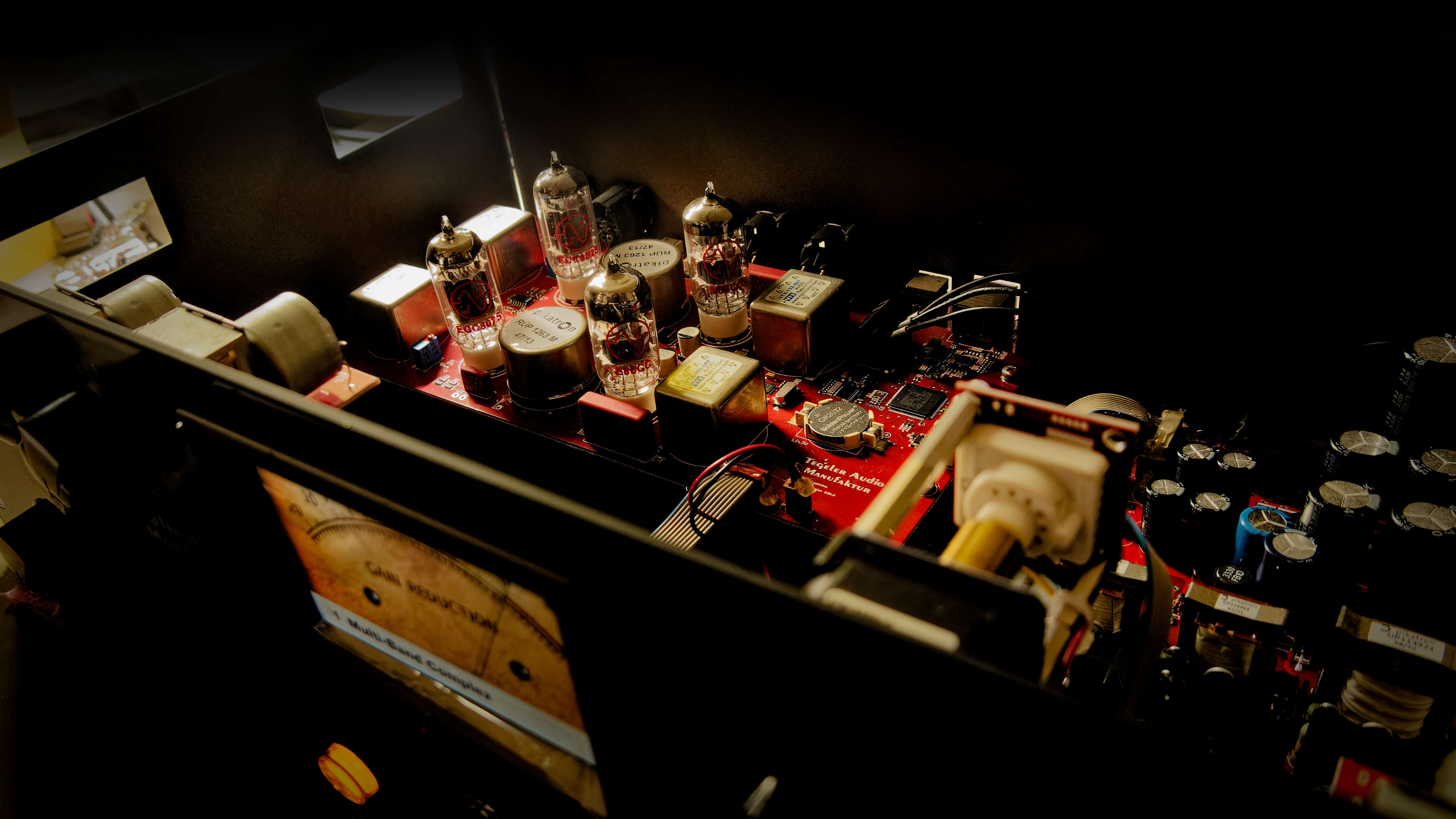
Schwerkraftmaschine. The signal path follows the same fully analog tube and transformer layout as the VTC, three transformers and two double triodes per channel. The difference is in the side-chain: the control signal is computed digitally. That lets the same vari-mu signal path take on the control behavior of very different compressors, eleven modes in total, from Classical VariMu through opto and VCA characteristics to programs that cannot exist in analog form. A VTC mode recreates the Vari Tube Compressor. Servo pots and a plug-in (VST, AU, AAX) make the unit remote-controllable and give it total recall: load the session and the knobs move into position by themselves. Sound On Sound gave the Schwerkraftmaschine its 2018 readers' award for "Best New Effects & Processing Hardware".
Vari Tube Recording Channel (VTRC). Vari-mu in the recording path. The VTRC is a tube channel strip with microphone preamp, passive Pultec-style equalizer and two compressors in one chain: an opto compressor for airy, level-holding work and a vari-mu stage for density and presence. The EQ can be switched into the side-chain, and the VTRC then compresses frequency-dependently or works as a de-esser. If you want to record a voice so that it already sits in the mix before a single plug-in is touched, this is both in one box.
Which one is right? The VTC if you want exactly that gentle, organic tube-and-transformer sound on the bus. The Schwerkraftmaschine if you need more than one compressor character or won't do without remote control and recall. The VTRC if the job is before the mix, at the recording stage.
Want to hear vari-mu compression in your own studio for 14 days?
More about the Vari Tube Compressor
More about the Schwerkraftmaschine
More about the VTRC