The Pultec Trick: Why Boost and Cut Don't Cancel
- 04.09.2026
- Michael Krusch
- Story
- Basics
- Tutorial
- EQP-1
Turn up the bass and turn it down at the same time. On paper that's nonsense. On a Pultec-style equalizer it's the single most copied EQ move in the history of recording, and the original manual explicitly told you not to do it. This is the Pultec trick: low-frequency boost and low-frequency attenuation on the same band, at the same frequency, at the same time. The result is not silence and not "nothing happens". The result is a low end that gets bigger and tighter at once.
We build a passive tube equalizer of this kind in Berlin, the Classic Equalizer EQP-1. So instead of the twentieth list of plug-in presets, here is the trick explained from the inside: where it comes from, why two controls that should cancel each other don't, how to set it on kick, bass and mix bus, what the lesser-known version in the top end does, and why all of this only works on a passive circuit.
What the Pultec trick is
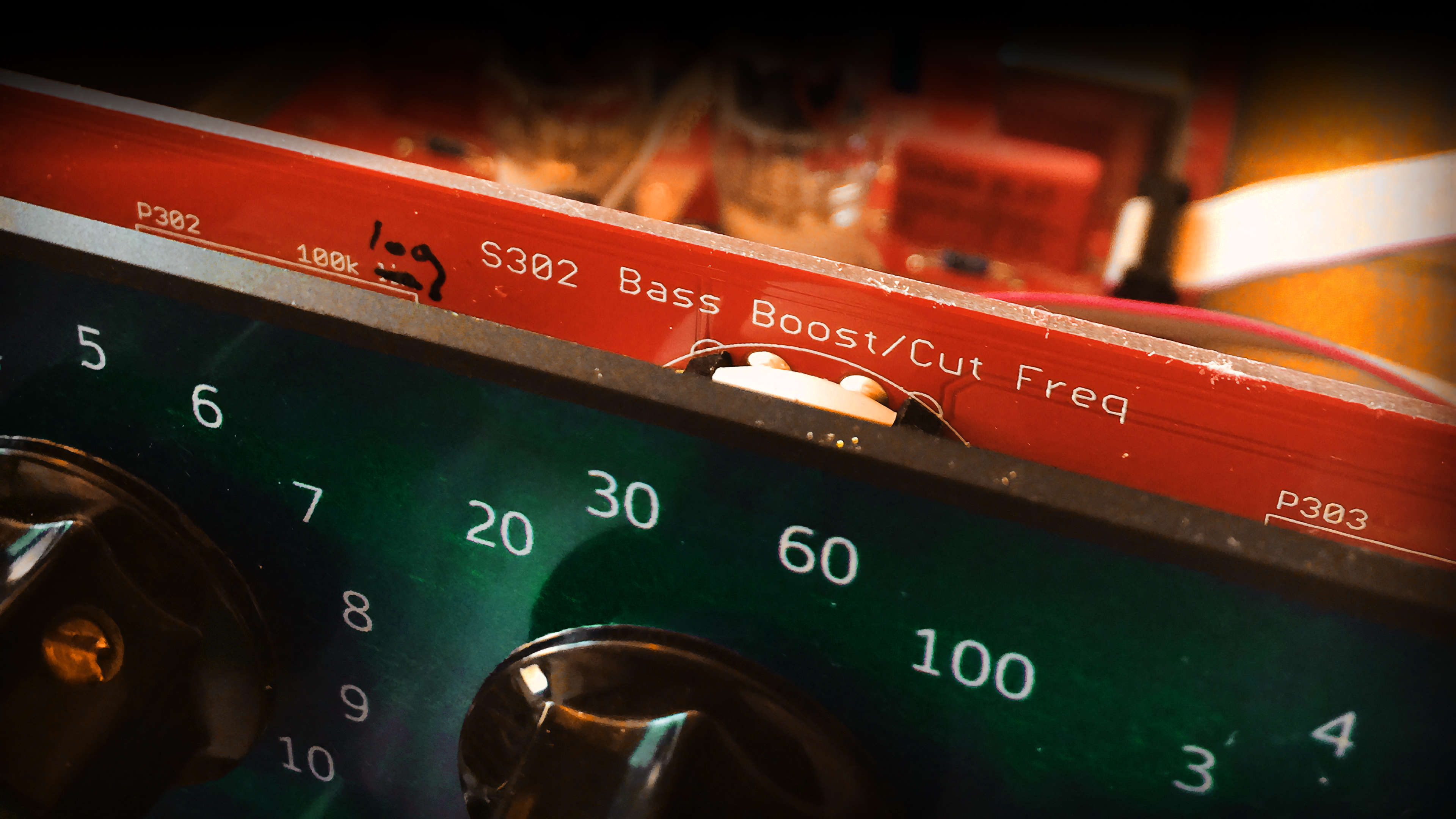
A Pultec-style EQ has a low-frequency section with three controls: a frequency selector (20, 30, 60 or 100 Hz), a BOOST knob and an ATTEN knob. Boost raises a shelf below the selected frequency. Atten lowers a shelf below the selected frequency. Logic says that if you turn both up, one undoes the other and you end up flat.
The Pultec trick is to ignore that logic. You pick a frequency, turn the boost up, and then turn the attenuation up as well, typically a little less than the boost. What you hear is a bass region that gains weight at the bottom while the mud just above it thins out. Kick drums get punch without boom. Bass guitars get foundation without the boxy lower mids. A full mix gets depth without turning into a sponge.
The manual of the original Pultec EQP-1A leaves no doubt about the designers' intention: "Do not attempt to boost and attenuate simultaneously on the low frequencies." Engineers did it anyway, found out that it sounded superb, and turned the forbidden setting into the most famous feature of the unit.
Where it comes from: the Pultec EQP-1A
"Pultec" is a contraction of Pulse Techniques, a small company that opened its doors on February 1, 1953 in Teaneck, New Jersey. Its founders were two engineers, Eugene Shenk and Ollie Summerlin; Shenk had spent fourteen years at RCA Communications before that. Their first equalizer, the EQP-1 Program Equalizer, appeared in the 1950s, initially with low-frequency boost and attenuation at 30, 60 and 100 Hz. The EQP-1A of the early 1960s added the 20 Hz position, more high-frequency options and the 5 and 20 kHz settings on the high-frequency attenuator. This is the unit everyone means when they say "Pultec". A 2U version, the EQP-1A3, followed in the 1970s with identical circuitry.
The design principle was typical of its time and is the reason the trick exists at all: the equalizer itself is passive. Capacitors, resistors and an inductor shape the frequency response without any active gain. A passive network can't add energy, only take it away, so at flat settings the signal comes out considerably quieter than it went in. A tube amplifier stage, in the EQP-1A a 12AX7 and a 12AU7 with three transformers in the signal path, makes the lost level back up. Program equalizer, passive filters, tube make-up gain: that is the recipe.
Pultecs went into Capitol, RCA Victor and Abbey Road, and they were built in one form or another until 1981, when Shenk wanted to retire and found no buyer. Original units have been changing hands for large sums ever since. In the early 2000s the name Pulse Techniques was revived, and the EQP-1A is built again to the original specification. Meanwhile the circuit has been copied, adapted and emulated by dozens of manufacturers, in hardware and as plug-ins.
Why boost and cut don't cancel each other
Here is the part most explanations skip, and it's the part that matters. The boost and the attenuation on a Pultec are not the same filter with the sign flipped. They are two different passive networks that happen to share a frequency switch. Their curves are not mirror images of each other.
Two things differ. First, the corner frequencies are not identical: Sound On Sound's measurements of the Pulse Techniques reissue show the attenuation curve starting roughly half an octave higher than the boost curve set to the same position. Second, the amounts differ: at the same knob position the boost gives slightly more gain than the attenuation takes away.
Add those two together and the sum of "boost plus cut" is not a straight line. Below the selected frequency, the boost wins and the shelf stays raised. Around and just above the selected frequency, the attenuation catches up and pulls the curve down, so you get a dip above your chosen frequency. On the reissue, Sound On Sound found it about an octave up; where exactly it lands depends on the two knob positions and on the individual unit. Set to 60 Hz, the unit lifts the fundamentals of kick and bass and at the same time carves out the lower mids where mixes get boomy and boxy. That's exactly the shape you'd draw by hand if someone asked you for "tight low end": a bump below, a scoop above.
Nothing in the documentation suggests this was designed. It is a side effect of building two separate networks as simply as possible with 1950s components, and the manual's warning shows that the designers considered it something to avoid. What makes the trick musical rather than accidental is that the two curves are broad and gentle. There are no narrow resonances, just two shallow slopes fighting each other. Passive networks with real components do that with a smoothness that is hard to draw in a parametric EQ with three bands.
How to set it: kick, bass, mix bus
There is no correct setting, but there are starting points that engineers have converged on over decades. On a Pultec-style unit the boost and attenuation scales run from 0 to 10, and that's how the numbers below are meant.
Kick drum. Frequency at 60 Hz for a rock or pop kick, 30 Hz if you want the weight lower and out of the way of the bass. Start with boost around 4 to 5 and attenuation around 3 to 4. Then move the attenuation up and down while listening to the region just above the kick's fundamental: that's where the trick either cleans up the boom or starts to sound hollow. Fab Dupont, who has demonstrated the trick extensively, works in exactly this range. And this is why boosting alone doesn't get you there: the boost is a shelf, so the mud above the fundamental comes up with it, and dialing the boost back to control the mud costs you the 60 Hz weight as well. The trick keeps the weight and removes the mud.
Bass guitar and synth bass. Same recipe, usually at 60 or 100 Hz, or at 20 or 30 Hz if you want weight without a rise in average level. Listen to where the dip lands in relation to the lower mids of the bass; that's the region that clouds a mix. If kick and bass fight, give them different frequency positions instead of the same one.
Mix bus and mastering. Here the trick becomes a seasoning, not a sculpting tool. Frequency at 20 or 30 Hz and both controls between 1 and 2 add depth to a mix without raising the average level much and without pushing the low end forward. Anything above 3 on the bus is audible as an effect, which is fine if that's what you want.
Snare, acoustic guitar, vocals, piano. Nobody talks about it, but the 60 and 100 Hz positions with moderate settings remove boxiness from close-miked sources while leaving them full. Think of it as a low cut with a body instead of a hole.
Two things to check every time. The boost is a shelf, so everything below your chosen frequency comes up too, including sub-bass you may not hear on small monitors: judge it on a system that reproduces 30 Hz or on good headphones. And the trick adds level in a region where our ears are less sensitive but meters are not, so compare with the bypass at matched loudness, not by ear alone. Louder always sounds better for the first ten seconds.
The other trick: the top end
Less famous, and in the manual expressly permitted. The high-frequency section of a Pultec-style EQ has a peaking boost with selectable center frequency and a bandwidth control, and separately a shelving attenuation at 5, 10 or 20 kHz. The original manual says about this section that "it is possible, and sometimes very desirable, to operate the right hand boost and attenuate controls simultaneously."
The classic combination is a broad boost between 10 and 16 kHz for air and openness, together with a gentle attenuation at 20 kHz. The boost adds sheen, the shelf takes the extreme top off again, and what's left is a high end that sounds open without getting brittle. It's a redistribution of energy, not a simple lift. For harsh sources, move the attenuation down to 10 kHz: the shelf then reaches into the boost region and takes the edge off while the peak keeps the air.
A second use of the top end has nothing to do with boosting at all. A gentle high-frequency attenuation at 5 kHz, on its own, rounds off a harsh drum bus or an aggressive overhead in a way that a parametric cut rarely manages, because the passive shelf is so shallow. Fredrik Kinbom, who uses our EQP-1 on drums, describes precisely this: "One of my favourite things about the EQP-1 is the way it can round off a harsh-sounding top end in a transparent and natural manner with a gentle cut at 5kHz, and of course the "Pultec trick" with a boost/cut on the low band. Magic on the drum bus!"
Why it only works on a passive EQ
Try the Pultec trick in the parametric EQ of your DAW: set a low shelf boost of 4 dB at 60 Hz and a low shelf cut of 4 dB at 60 Hz. You get a flat line. In a typical digital EQ the boost and cut curves are exact mirror images, so at the same frequency and slope they cancel to the decimal. The trick lives entirely in the imperfection of two passive networks that were never designed to mirror each other.
That's why every plug-in that offers the trick has to model the original circuit, component by component, rather than compute an ideal shelf. Good emulations get the curves right. What they can only approximate is the rest of the signal path: the inductor with its own saturation, the tube stage that adds a rising second harmonic as the level goes up, the transformers at input and output. On a hardware unit these are not features you switch on. They are simply what the signal passes through, at every setting, including flat. Amazona.de, comparing our EQP-1 with a well-known Pultec plug-in in 2024, put the difference this way: "The plug-in always sounds a bit fatter and punchier, while the Tegeler works much more subtly. The hardware conveys more transparency and resolution, and the plug-in is always a little coarse in comparison." (translated from the German)
The Pultec trick on the Classic Equalizer EQP-1
The same interaction is there on our Classic Equalizer EQP-1, because it works on the same principle: a passive filter section with capacitors and inductors, followed by a tube amplifier stage and input and output transformers. It is not a clone, and its curves are its own. As Amazona.de put it in its review, the EQP-1 is "not a Pultec clone" but "respectfully takes the venerable ancestor as its model" and carries its sound "into the modern age". Same idea, our own circuit.
The low-frequency section offers boost and cut at 20, 30, 60 and 100 Hz. What the boost-plus-cut setting does on this unit is best described by someone who measured it against a plug-in: "By simultaneously cutting and boosting the bass, the low end gets an unmistakable push and a very characteristic warmth", to quote Amazona once more (translated from the German). The high-frequency boost has nine center frequencies from 3 to 20 kHz with a WIDTH control for the bandwidth, and the high-frequency cut sits at 5, 10 or 20 kHz. If you'd rather hear it than read about it, the Polish channel "Na czym gra" demonstrated the boost-plus-cut setting on the EQP-1 in four videos.
One thing the EQP-1 does differently from the original: it has two channels in one 2U housing, each with its own filter section and bypass switch. Stereo mix bus, mastering, or two mono sources at once, without a second unit. For the trick on a stereo bus that matters more than it sounds, because both channels sit on the same front panel and can be set to the same values side by side.
Within our range, the EQP-1 is the one for broad, musical strokes. The Creme carries a passive boost-only EQ of the same family next to its bus compressor, cleaner and without tubes, made for a few dB of bass and treble lift on the mix bus. The MythEQ 500 is the surgical one. How the EQP-1 sits in a mastering chain next to our tube compressor is described by Andreas Bicking on the mix bus with VTC and EQP-1, and if you want to know what the compressor in that chain does, read how a vari-mu compressor works.
Want to try the Pultec trick on the Classic Equalizer EQP-1 in your own studio for 14 days?
More about the Classic Equalizer EQP-1
